Guides
Birth-chart accuracy suite
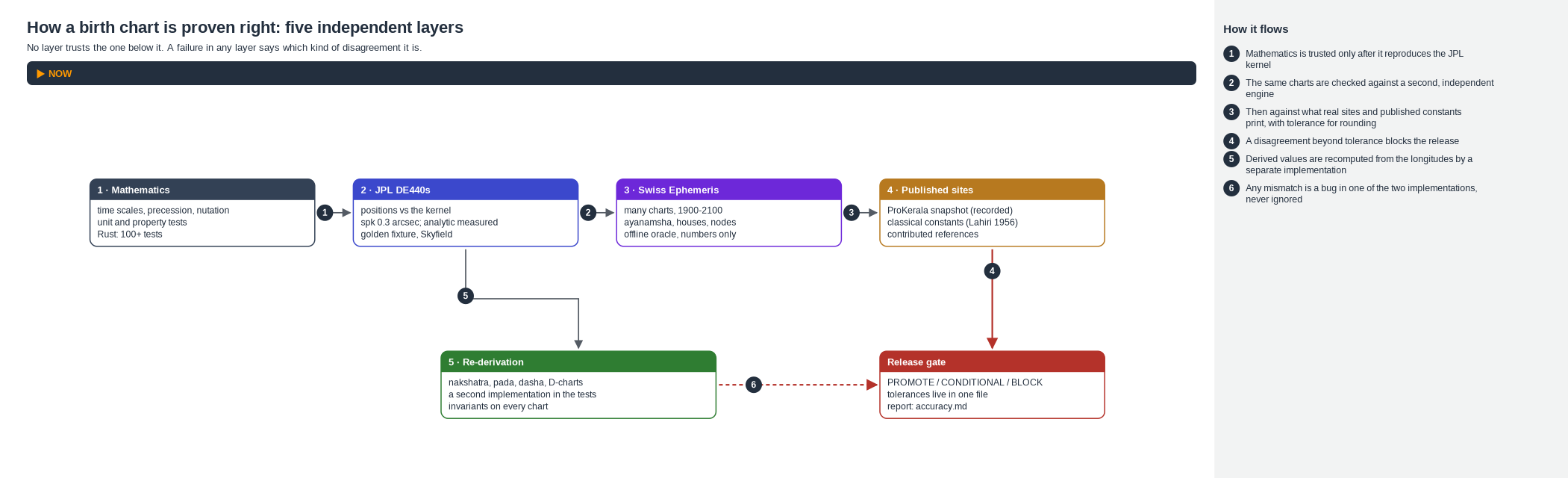
A birth chart is only useful if its numbers are right. The suite in accuracy/ checks every part
of a chart against something ESHANA did not compute. Measured results:
benchmarks/accuracy/birth-chart-accuracy.md.
Run it
make accuracy-suite                                    # analytic provider (no data files)
ESHANA_SPK=/path/de440s.bsp make accuracy-suite        # also the spk provider
make accuracy-report                                   # rewrite the measured tables; fails if a margin is gone
About 1,300 checks run in under three seconds. The suite needs only the installed eshana package and the committed
reference files. It does not need the Swiss Ephemeris, a network connection or a website.
The layers
| # | Layer | What is compared | Reference |
|---|---|---|---|
| 1 | Positions | sidereal and tropical longitude of 10 planets and both nodes; effective Lahiri ayanāṃśa | Swiss Ephemeris (Moshier), 44 charts |
| 1 | Houses | Ascendant, MC and 12 cusps for whole-sign, equal and Placidus, in both zodiacs; Placidus refused inside the polar circles | Swiss Ephemeris |
| 2 | Categories | rāśi, nakshatra, pada, lagna, and every varga D3–D12, re-derived from the Swiss longitude | Swiss + textbook rules |
| 3 | Re-derivation | ESHANA’s own longitudes run through a second implementation of the rules: sign, nakshatra, pada, lord, bhāva, D3–D12 for every body and the lagna, Vimśottarī balance, every mahādaśā date, every antardaśā length | accuracy/lib.py (shares no code with the engine) |
| 3 | Daśā vs Swiss Moon | starting lord and balance from the Swiss Moon, within the balance the Moon tolerance allows | Swiss |
| 4 | Published values | Lahiri = 23°15′00″ on 1956-03-21 (the definition); a full ProKerala chart | published.json |
| 5 | Civil time | local time → UTC and offset for every chart | Python zoneinfo, an independent tz implementation |
| 6 | Pañcāṅga | tithi, karaṇa, nakshatra and yoga from the Swiss Sun and Moon; sunrise, sunset, moonrise and moonset (upper limb) on 40 charts | Swiss Ephemeris |
| 6 | Special lagnas | Bhāva, Horā and Ghaṭī lagnas | PyJHora’s book-checked test values (within 2′) |
| 7 | Ingresses | every sidereal ingress of the Sun, Jupiter and Saturn, 1990–2030, retrograde re-entries included | Swiss Ephemeris (SPK: within 3 minutes) |
| 8 | Vargas to D60, KP lords, aṣṭakavarga, aṣṭakūṭa | re-derived in Python from ESHANA’s longitudes and from the YAML packs | accuracy/lib.py, the packs |
The chart set
There are 44 charts across 16 cities: Delhi, Chennai, Mumbai, Kathmandu (UTC+5:45), Colombo, London, New York,
Fredericksburg, Los Angeles, Sydney, Buenos Aires, Johannesburg, Tokyo, Reykjavík, Tromsø (inside the Arctic Circle)
and Singapore. Dates run from 1905 to 2099; four more (1852, 1866, 2125 and 2140) are for the spk range only. They
include DST transitions, a leap day, midnight and 23:59, and both hemispheres. Edit scripts/build_reference.py to
add charts, then run
uv run --no-project --with pyswisseph python scripts/build_reference.py.
Tolerances and why
Tolerances live in one file, accuracy/tolerances.json. Each sits above its
measured worst case with a margin; make accuracy-report fails if a measured value reaches its tolerance.
| Provider | Planets | Moon | Nodes | Angles and cusps |
|---|---|---|---|---|
spk (JPL DE440s) |
1.5″ (measured ≤ 0.5″) | 4″ (2.1″) | mean 1″, true 60″ | 6″ (3.2″); whole-sign exact |
analytic (no files) |
30″ for the Sun to 1100″ for Saturn (see the file) | 15″ (6.3″) | mean 1″, true 400″ | the same |
ΔT is corrected, not hidden. For dates after 2027 both ESHANA and the Swiss Ephemeris forecast ΔT, and the two forecasts differ: by 2140 the difference is about 97 s, which moves the Moon about 53″. The suite records the Swiss ΔT for each chart and removes exactly that difference before comparing, so it tests the ephemeris and not two guesses about the future. The uncorrected Moon is still printed in the report.
Boundaries are counted, not passed. If a reference longitude lies within tolerance of a sign, nakshatra, pada or varga boundary, the categorical check for that value is undecidable. It is skipped and counted (11 of 440 values for the analytic provider, none for spk), never quietly passed.
Published sources
Lahiri definition
The Calendar Reform Committee of the Government of India (1955) fixed the Lahiri ayanāṃśa at 23°15′00″ on 21 March 1956. ESHANA reproduces it within 3″ under both providers.
ProKerala
ProKerala’s sidereal planet positions page was read on 2026-11-20 for 07:01 EST, Fredericksburg, Virginia. Every graha, its rāśi, nakshatra, pada, retrograde flag and whole-sign house agree. The degree differences (ESHANA minus ProKerala) are informative:
| analytic | spk | |
|---|---|---|
| Sun, Mercury, Venus, Mars, Jupiter, Saturn | −7″ to +280″ (analytic Jupiter and Saturn) | −6.7″ to −9.5″ |
| Moon | −17.7″ | −20.2″ |
| Lagna | −0.08° | −0.08° |
| Rahu (mean node) | −7.3″ | −7.3″ |
With the precise provider every slow body is offset by the same 7–9″. That is the signature of an ayanāṃśa
difference, not an ephemeris error: ProKerala’s Lahiri value is about 8″ smaller than the Swiss and ESHANA definition.
The Moon and lagna differ more. The page prints the minute, not the second, so a reading taken about 20 s after 07:01
would move the Moon about 12″ and the lagna about 0.08°, which matches. These assumptions are written next to the
numbers in published.json, and the test tolerances name them (ayanamsha_variant_arcsec, unstated_location_deg).
Adding a published chart
- Use a page that prints the input (date, time with seconds if possible, zone or offset, place) and the output to at least 0.01°. Record the URL and the date you read it.
- Copy the printed values verbatim into a new entry under
prokerala_snapshots(or a new list for another site) inaccuracy/reference/published.json. Write down every assumption you had to make. - Run
make accuracy-suite. If something disagrees, find out why before changing a tolerance. So far every disagreement has been a real bug or a stated convention.
The ProKerala API documentation and the AstroSage and Drik Panchang chart tools were also checked. They need a form submission or render in the browser, so they have no fixed published example to record.
Bugs this suite found
| Bug | Fixed in | Regression test |
|---|---|---|
| Sidereal whole-sign cusps started one sign early when the sidereal Ascendant was less than the ayanāṃśa past a sign boundary | eshana-engine/src/api.rs |
whole_sign_cusps_start_at_the_ascendant_sign_in_both_zodiacs |
| Ketu had no tropical longitude | api.rs |
south_node_carries_its_tropical_longitude |
| The last antardaśā could end 1 ms away from its mahādaśā (floating-point seam) | vedic.rs |
dasha_structure_and_balance |
| Combustion and dig bala used a signed angle, so every graha behind the Sun read as combust | jyotish.rs |
combustion_and_dig_bala_use_the_unsigned_separation |
| A pañcāṅga at the very end of the provider’s range failed instead of reporting “no event in range” | panchanga.rs |
test_panchanga_limbs_match_swiss[...2099-12-31...] |