Concepts
Architecture
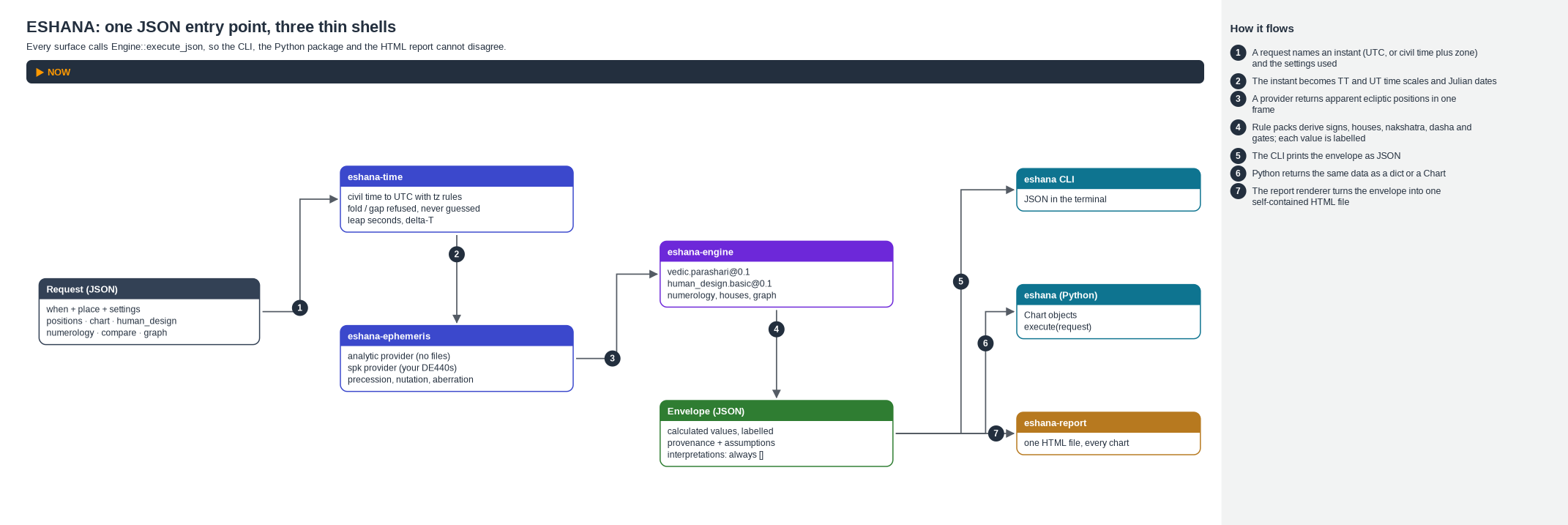
All five animated diagrams, generated from code, are on the architecture diagrams page.
flowchart TD
  U[Request JSON] --> E[Engine::execute_json]
  E --> T[eshana-time: civil to UTC, TT, JD, sidereal time]
  T --> P[EphemerisProvider]
  P --> A[analytic: VSOP87 + lunar series]
  P --> S[spk: JPL kernel you supply]
  P --> F[frames: precession, nutation, aberration]
  F --> D[Derivation: houses, Vedic, Western, Human Design]
  U --> N[Numerology]
  D --> G[Symbolic graph]
  D --> X[Envelope: positions, derived, provenance]
  N --> X
  G --> X
  X --> CLI[eshana CLI]
  X --> PY[Python via PyO3]
  X -.-> JS[Node / WASM: planned]
  X -.-> MCP[MCP server: planned]
Crates
| Crate | Responsibility |
|---|---|
eshana-core |
typed angles, Body, CalculationConfig, Epistemic, Provenance, DerivedAttribute, errors with stable ESH-* codes |
eshana-time |
IANA civil time to UTC, leap seconds, ΔT, TT, Julian day, GMST |
eshana-ephemeris |
the EphemerisProvider trait; analytic and spk providers; reference-frame arithmetic |
eshana-engine |
houses and geometry, Vedic, Western, Human Design and numerology rule packs, graph, comparison, and the JSON API |
eshana-cli |
the eshana binary; a thin shell over the engine’s JSON entry point |
eshana-python |
the PyO3 module eshana._native (one function) and the eshana Python package |
The master plan sketches sixteen crates; 0.1 deliberately starts with six and keeps traditions as modules inside
eshana-engine until their APIs stabilise (ADR-006).
One entry point
Every surface builds a JSON request and calls Engine::execute_json. There is no second implementation of any rule in
any binding. This is why the Python and CLI outputs are byte-for-byte the same JSON, and why the acceptance suite can
assert it. Adding a language binding means writing a shell around one function.
One frame
Every provider returns the same thing: geocentric, apparent (light-time and annual aberration corrected),
ecliptic longitude and latitude of the true equinox of date. Providers differ in accuracy, never in definition,
so switching provider changes digits, not meaning. The frame’s name is in every result
(geocentric_apparent_ecliptic_true_equinox_of_date).
Determinism
No clock, no randomness, no network, no global mutable state beyond a provider cache. Identical requests produce identical bytes (acceptance scenario). Maps are ordered, floating-point formatting is the shortest round-trip form, and nothing depends on the machine’s locale or time zone.