Policy Engine & Security
Ananke's policy engine is the "Ananke" layer — the hard constraints that govern every agent action.
Policy categories
| Category | Example policies |
|---|---|
| Architecture | No domain cycles; no forbidden imports |
| Security | No secrets committed; SAST must pass |
| Quality | Ruff clean; mypy strict; coverage ≥ 85% |
| Testing | Tests must pass before push |
| Model compatibility | Schema changes must be backward-compatible |
| Dependency | No CVEs without documented exception |
| License | No GPL in production dependencies |
| Git | No force-push to main |
| Lifecycle | Jira must be In Progress before implementation |
| Agent permissions | Skills cannot access secrets directory |
| Network | Default deny; allow-list per skill |
| Filesystem | Skills restricted to declared read/write globs |
| Release | SBOM required; provenance attestation required |
| Evidence | Evidence bundle must exist before PR creation |
Gate severity
| Severity | Effect |
|---|---|
info |
Logged only |
low |
Warning |
medium |
Warning in CI; may block in strict mode |
high |
Blocks unless policy says warn |
critical |
Always blocks |
Hard gates: PASS | BLOCKED | ERROR
Soft gates: PASS | WARN | SKIPPED | UNAVAILABLE
Tools not installed return UNAVAILABLE. Policy decides whether that blocks or warns.
Builtin policy packs
Install a pack into your project:
ananke policy install-pack baseline
ananke policy install-pack python-library
ananke policy install-pack agentic-security
ananke policy install-pack enterprise-strict
baseline
Minimal rules for any Ananke project:
- policy.core.fail-closed — ensures fail_closed = true in config
- security.no-secret — gitleaks must find no secrets (pre-commit)
python-library
For Python library and service projects: - Ruff check (pre-commit) - mypy strict (verify) - Test coverage ≥ 85% (verify) - pip-audit clean (verify) - License scan (verify, warn)
agentic-security
For projects with autonomous agents: - No secrets in prompts (gitleaks) - SAST clean (semgrep) - Dependency audit (pip-audit) - Trivy filesystem scan - Architecture: no domain cycles (pre-push)
enterprise-strict
All of the above, at critical severity, blocking.
Writing custom policies
Create .ananke/policy/my-rules.toml:
[[rule]]
id = "arch.no-domain-cycle"
stage = "pre_push"
severity = "high"
gate = "architecture"
assert = "graph.domain_cycles == 0"
on_failure = "block"

[[rule]]
id = "security.no-secret"
stage = "pre_commit"
severity = "critical"
gate = "gitleaks"
assert = "findings.count == 0"
on_failure = "block"

[[rule]]
id = "tests.minimum-coverage"
stage = "verify"
severity = "medium"
gate = "pytest"
assert = "coverage.line >= 85"
on_failure = "block"
Policy commands
# List active rules
ananke policy list --project .
ananke policy list --json

# Evaluate a stage
ananke policy check --stage verify
# exits 0 if pass, 3 if blocked

# Explain gate decisions
ananke policy explain --stage pre_commit
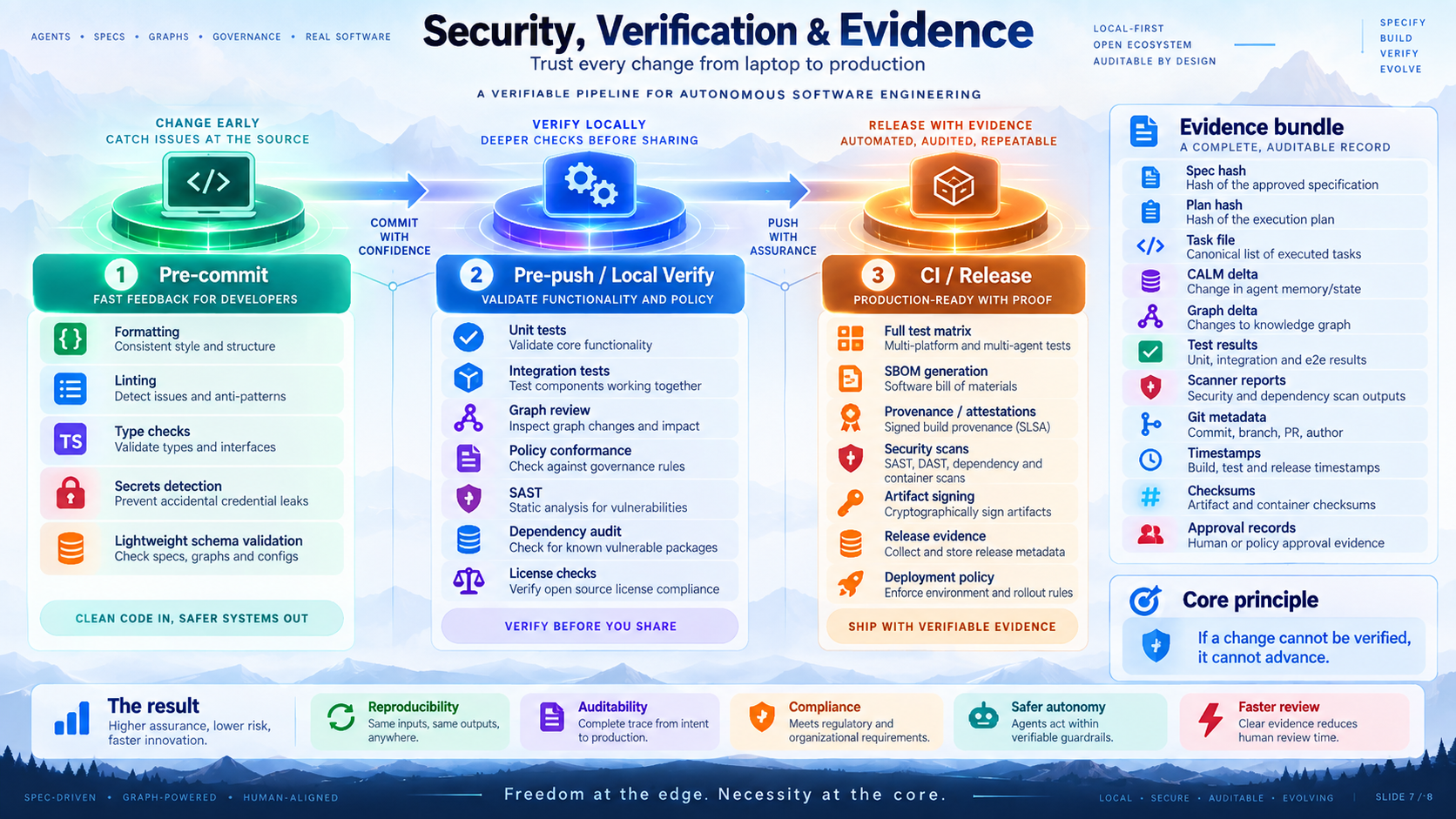
Security — a layered system
Ananke does not reduce "security" to one scanner. Security is layered:
flowchart TB
    CHANGE["💻 Code Change"]
    SECRET["🔑 Secrets — Gitleaks"]
    SAST["🛡️ SAST — Semgrep"]
    DEPS["📦 Dependencies — pip-audit"]
    LICENSE["⚖️ Licenses — pip-licenses"]
    CONTAINER["📦 Container — Trivy"]
    WORKFLOW["🔧 Workflows — actionlint/zizmor"]
    SBOM["📑 SBOM — CycloneDX"]
    PROV["🔏 Provenance — Attestations"]

    CHANGE --> SECRET
    CHANGE --> SAST
    CHANGE --> DEPS
    CHANGE --> LICENSE
    CHANGE --> CONTAINER
    CHANGE --> WORKFLOW
    DEPS --> SBOM
    SBOM --> PROV
Scanner surface
| Concern | Tool |
|---|---|
| Python quality | Ruff |
| Type safety | mypy |
| Secrets | Gitleaks |
| SAST | Semgrep |
| Python CVEs | pip-audit |
| Container/filesystem CVEs | Trivy |
| Workflow security | actionlint, zizmor |
| Code scanning | CodeQL |
| SBOM | CycloneDX |
| Provenance | GitHub artifact attestations |
Tools are detected at runtime — if not installed, they produce UNAVAILABLE rather than silently passing.
Agentic security threat model
Ananke addresses agent-specific risks:
| Risk | Mitigation |
|---|---|
| Prompt injection from repo content | Repository content treated as untrusted input |
| Tool escalation | Tool allowlists + policy evaluation before every call |
| Secret exposure | APM sandbox blocks reads of .ananke/secrets/** |
| Network exfiltration | Default deny; per-skill allow-list |
| Dependency hallucination | APM verifies packages before install |
| Approval bypass | Required approval classes enforced in run engine |
| Evidence tampering | SHA-256 checksums and manifest hashes |
Evidence bundle
Every verification run produces an immutable evidence bundle:
.ananke/evidence/<run-id>/
├── manifest.json          — file hashes
├── run.json               — run metadata
├── policy-decisions.jsonl — every gate decision
├── checksums.sha256       — integrity file
└── gates/
    ├── ruff.json
    ├── mypy.json
    ├── pytest.json
    ├── gitleaks.json
    ├── semgrep.json
    ├── pip-audit.json
    ├── trivy.json
    ├── license.json
    └── sast.sarif         — SARIF 2.1.0 for security findings
The SARIF file can be uploaded directly to GitHub Security tab.