Code Graph Intelligence
Ananke treats your repository as a graph of semantic relationships, not a flat directory tree.
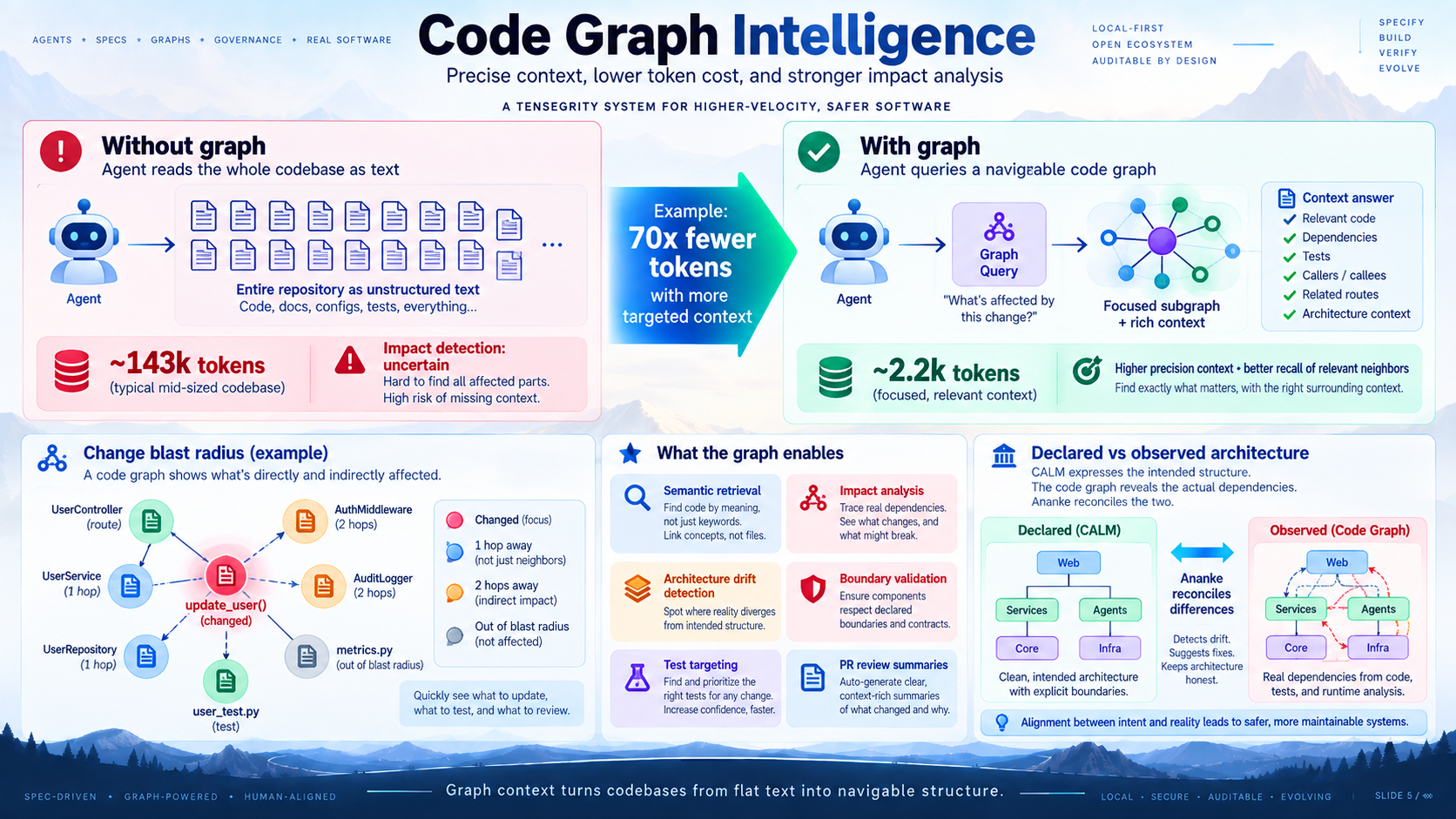
Why graph context changes everything
Without graph intelligence:
With graph intelligence:
The objective is not merely fewer tokens. It is better context selection — giving the agent exactly the code it needs to understand the impact of a change.
Canonical graph model
All providers normalize to the same types.
Node kinds
| Kind | Represents |
|---|---|
file |
Source file |
function |
Function definition |
class |
Class definition |
method |
Class method |
module |
Python module |
route |
HTTP API endpoint |
table |
Database table |
queue |
Message queue |
service |
Service component |
requirement |
Requirement artifact |
test |
Test function |
skill |
APM skill |
tool |
MCP tool |
architecture_component |
CALM component |
Edge kinds
| Kind | Meaning |
|---|---|
imports |
Module/file imports another |
calls |
Function calls another |
inherits |
Class inherits from another |
implements |
Class implements interface |
reads |
Component reads from store |
writes |
Component writes to store |
publishes |
Component publishes event |
subscribes |
Component subscribes to event |
tests |
Test covers function/class |
realizes |
Implementation realizes spec |
depends_on |
Component depends on another |
owns |
File owns function/class |
violates |
Component violates constraint |
constrained_by |
Component constrained by policy |
Edge provenance
Each edge carries:
- origin: extracted | inferred | ambiguous | declared
- provider: which adapter produced the edge
- confidence: float 0.0–1.0
- source_location: file:line where the relationship was found
Blast radius analysis
When authenticate() changes, Ananke traverses the graph:
graph TD
    AUTH["🔴 authenticate()<br/>CHANGED"]
    REQUIRE["🟠 require_auth()"]
    LOGIN["🟠 login()"]
    ROUTE["🟡 protected_route()"]
    API["🟡 login_route()"]
    TESTAUTH["🟢 test_auth()"]
    TESTLOGIN["🟢 test_login()"]

    REQUIRE --> AUTH
    LOGIN --> AUTH
    ROUTE --> REQUIRE
    API --> LOGIN
    AUTH --> TESTAUTH
    LOGIN --> TESTLOGIN
This answers: - What may break? - Which tests matter? - What architecture components are involved? - Which routes rely on the changed symbol?
Building and querying the graph
# Build/update the code graph
ananke graph build --project .

# Query the graph for a symbol
ananke graph query --text "authenticate"

# Calculate impact of changed files
ananke graph impact --files src/auth.py src/middleware.py

# Export the graph as JSON
ananke graph export --format json

# Check graph status
ananke graph status
Graph providers
Native (built-in)
AST-based Python analysis. Always available, no dependencies.
- Extracts: files, functions, classes, imports
- Populates:
owns,importsedges - Best for: quick local analysis, CI without external tools
Graphifyy adapter
When graphifyy is installed, provides broad knowledge-graph enrichment and multi-source relationships. Falls back to native when unavailable.
code-review-graph adapter
When code-review-graph is installed, provides structural code review and incremental blast-radius analysis. Falls back to native when unavailable.
Multi-provider reconciliation
When multiple providers run, edges are reconciled:
| Status | Meaning |
|---|---|
CONSENSUS |
Multiple providers agree |
SINGLE_SOURCE |
Only one provider found this edge |
CONFLICT |
Providers disagree |
UNKNOWN |
No provider has data |
Impact report
The impact report includes:
{
  "changed_files": ["src/auth.py"],
  "impacted_symbols": ["function:src/auth.py:authenticate", "class:src/auth.py:AuthService"],
  "impacted_files": ["src/middleware.py"],
  "forbidden_edges": [],
  "blast_radius": 15,
  "summary": "1 changed, 14 impacted symbols, 1 impacted files"
}
Architecture reconciliation
Ananke compares declared architecture (CALM) with observed architecture (graph):
DECLARED  = architecture intended by CALM
OBSERVED  = architecture found in source/graph
DELTA     = observed − declared / declared − observed
Findings include: - Undeclared dependency - Declared relationship not found in code - Protocol mismatch - Forbidden cross-domain edge - Interface changed without model version bump