Ananke Plexus
Freedom at the edge. Necessity at the core.
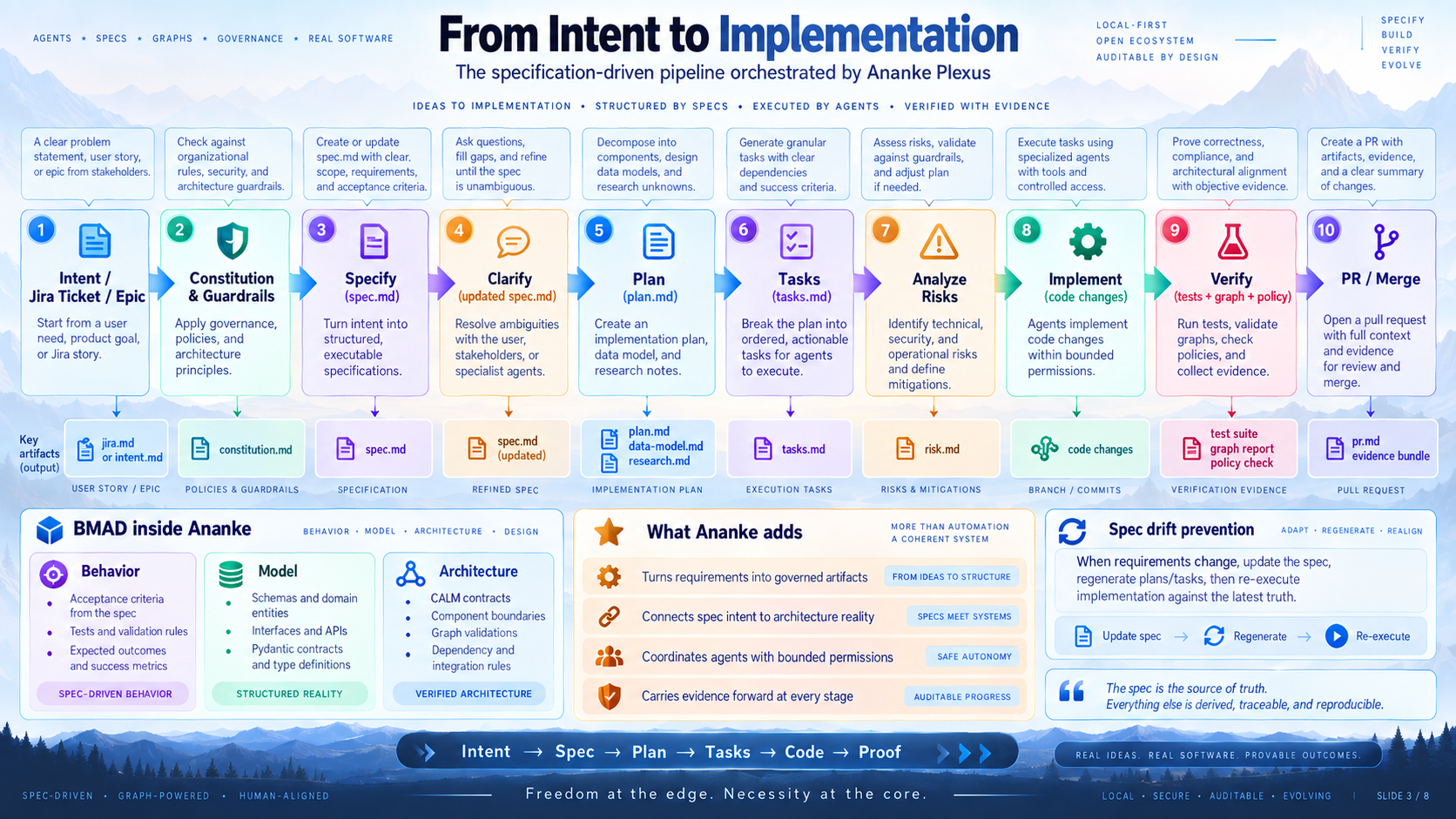
Ananke Plexus is a local-first Agent Development Life Cycle (ADLC) control plane — a tensegrity engineering harness that gives AI coding agents architectural context, deterministic guardrails, security gates, and verifiable delivery evidence.
What it does
Ananke Plexus connects specifications, CALM architecture, code graphs, tests, security scanners, MCP tools, agent skills, Git, Jira, and pull requests into one governed development lattice.
| Layer | What Ananke provides |
|---|---|
| Specification | Requirement capture → spec → plan → tasks → BMAD contracts |
| Architecture | FINOS CALM declarations, declared vs observed reconciliation |
| Graph intelligence | AST code graph, blast-radius impact, Graphifyy & CRG adapters |
| Policy engine | Lint, tests, secrets, SAST, SCA, licenses, architecture gates |
| Agent backends | GitHub Copilot, Amazon Q, Kiro, Hermes, generic CLI, fake/demo |
| MCP server | Read-only + mutation tools, dynamic resource registry |
| APM | Agent skill package manager with lockfile, sandbox, provenance |
| Skill & Agent Registry | Immutable, content-addressed skills/agents with importers, policy-aware resolver, ananke.lock, activation and generated docs |
| Evaluation & testing | Enterprise eval harness and unified test/quality harness with evidence |
| Lifecycle | Jira, Bitbucket, Git worktrees, PR evidence storytelling |
| Evidence | SARIF 2.1.0, SHA-256 manifests, policy decisions, checksums |
Quick start
pip install ananke-plexus
# or:
uv tool install ananke-plexus

cd my-project
ananke init
ananke doctor
Create a requirement and compile BMAD contracts:
ananke spec create --id PROJ-101 \
  --title "Add idempotent webhook" \
  --acceptance "duplicate events deduplicated" \
  --acceptance "idempotency key stored"

ananke bmad compile --feature-dir .ananke/specs/PROJ-101
Run full verification and generate evidence:
Register a skill and resolve it reproducibly:
ananke registry init
ananke registry learn ./skills/graph-review
ananke registry promote core/graph-review@1.0.0 --trust approved --channel stable
ananke registry resolve core/graph-review@^1 --explain
ananke sync            # writes ananke.lock
Serve the MCP server:
Documentation
| Section | Description |
|---|---|
| Why Ananke | Problems solved, tensegrity philosophy |
| Architecture | System design, ports & adapters |
| BMAD Contracts | Behavior, Model, Architecture compilation |
| Graph Intelligence | Code graph, blast radius, providers |
| Policy & Security | Policy engine, packs, security gates |
| MCP & APM | MCP server and Agent Package Manager |
| Skill & Agent Registry | Artifact model, trust, resolver, lockfile, security |
| Registry Guide | Hands-on tour: learn, promote, resolve, sync, publish |
| Registry Reference | CLI, manifest, policy, resolver, schemas, Python API |
| Evaluation Harness | Agent quality: traces, evaluators, judges |
| Testing & Quality Harness | Unified test runner, profiles, quality gate |
| Getting Started | Install, init, first spec, first verify |
| CLI Reference | Full command taxonomy |
| Configuration | Config files, secrets, precedence |
| Policy Reference | Rule syntax, builtin packs |
| Release Guide | PyPI Trusted Publishing workflow |
The core thesis
Agents receive freedom of action only through a stronger surrounding structure of truth.
flowchart LR
    INTENT["🎯 Intent"] --> SPEC["📜 Specification"]
    SPEC --> ARCH["🏗️ Architecture"]
    ARCH --> GRAPH["🕸️ Code Graph"]
    GRAPH --> POLICY["🛡️ Policy"]
    POLICY --> AGENT["🤖 Agent"]
    AGENT --> VERIFY["🧪 Verification"]
    VERIFY --> EVIDENCE["🧾 Evidence"]
    EVIDENCE --> DELIVERY["🚀 Delivery"]
Docs workflow
A GitHub Pages workflow publishes this site from main to gh-pages automatically.