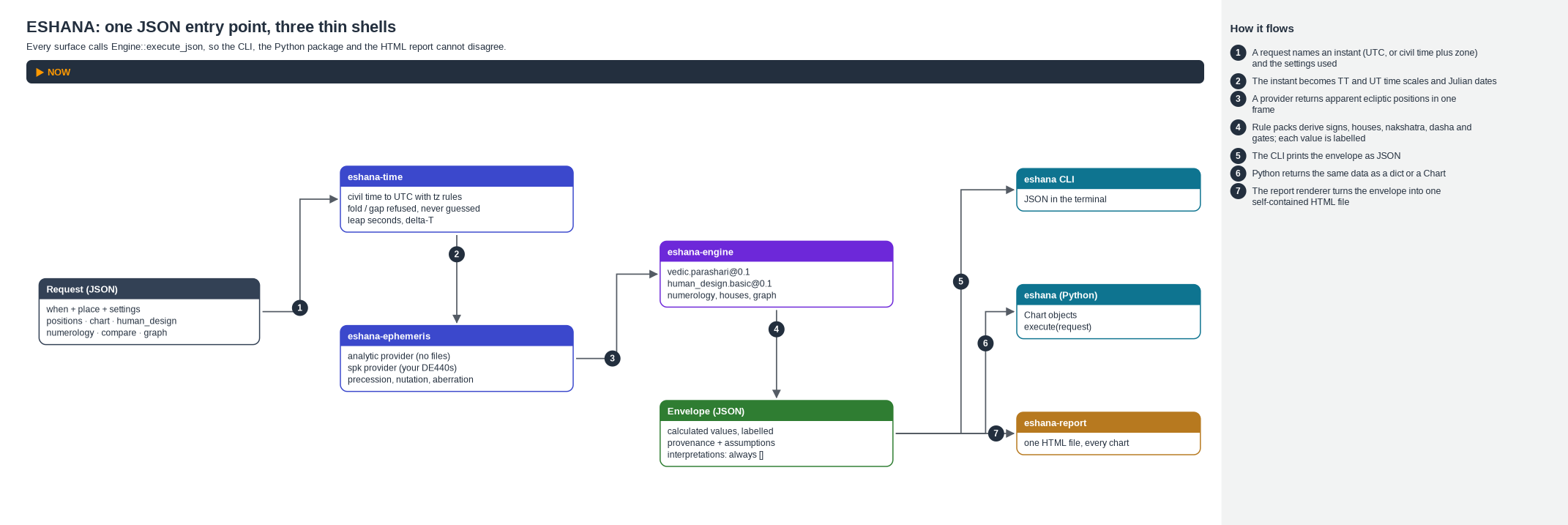
ESHANA: one JSON entry point, three thin shells
Every surface calls Engine::execute_json, so the CLI, the Python package and the HTML report cannot disagree.
Download: animated SVG · draw.io (editable)
The numbered steps
| # | From → to | What happens |
|---|---|---|
| 1 | Request (JSON) → eshana-time | A request names an instant (UTC, or civil time plus zone) and the settings used |
| 2 | eshana-time → eshana-ephemeris | The instant becomes TT and UT time scales and Julian dates |
| 3 | eshana-ephemeris → eshana-engine | A provider returns apparent ecliptic positions in one frame |
| 4 | eshana-engine → Envelope (JSON) | Rule packs derive signs, houses, nakshatra, dasha and gates; each value is labelled |
| 5 | Envelope (JSON) → eshana CLI | The CLI prints the envelope as JSON |
| 6 | Envelope (JSON) → eshana (Python) | Python returns the same data as a dict or a Chart |
| 7 | Envelope (JSON) → eshana-report | The report renderer turns the envelope into one self-contained HTML file |
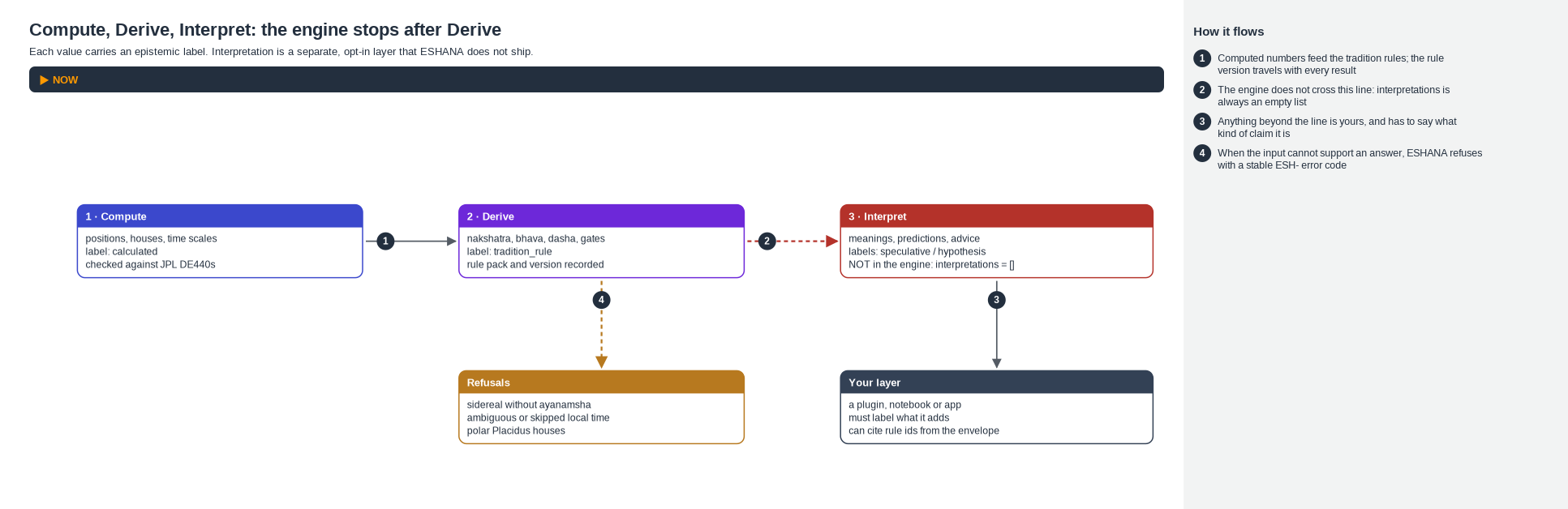
Compute, Derive, Interpret: the engine stops after Derive
Each value carries an epistemic label. Interpretation is a separate, opt-in layer that ESHANA does not ship.
Download: animated SVG · draw.io (editable)
The numbered steps
| # | From → to | What happens |
|---|---|---|
| 1 | 1 · Compute → 2 · Derive | Computed numbers feed the tradition rules; the rule version travels with every result |
| 2 | 2 · Derive → 3 · Interpret | The engine does not cross this line: interpretations is always an empty list |
| 3 | 3 · Interpret → Your layer | Anything beyond the line is yours, and has to say what kind of claim it is |
| 4 | 2 · Derive → Refusals | When the input cannot support an answer, ESHANA refuses with a stable ESH- error code |
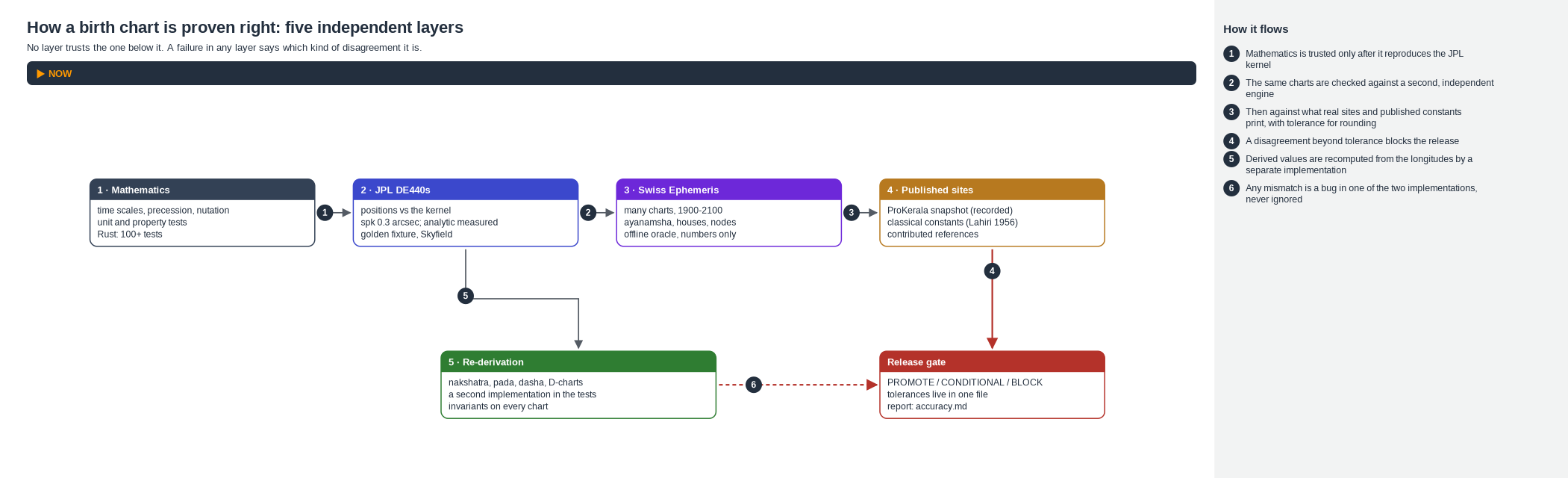
How a birth chart is proven right: five independent layers
No layer trusts the one below it. A failure in any layer says which kind of disagreement it is.
Download: animated SVG · draw.io (editable)
The numbered steps
| # | From → to | What happens |
|---|---|---|
| 1 | 1 · Mathematics → 2 · JPL DE440s | Mathematics is trusted only after it reproduces the JPL kernel |
| 2 | 2 · JPL DE440s → 3 · Swiss Ephemeris | The same charts are checked against a second, independent engine |
| 3 | 3 · Swiss Ephemeris → 4 · Published sites | Then against what real sites and published constants print, with tolerance for rounding |
| 4 | 4 · Published sites → Release gate | A disagreement beyond tolerance blocks the release |
| 5 | 2 · JPL DE440s → 5 · Re-derivation | Derived values are recomputed from the longitudes by a separate implementation |
| 6 | 5 · Re-derivation → Release gate | Any mismatch is a bug in one of the two implementations, never ignored |
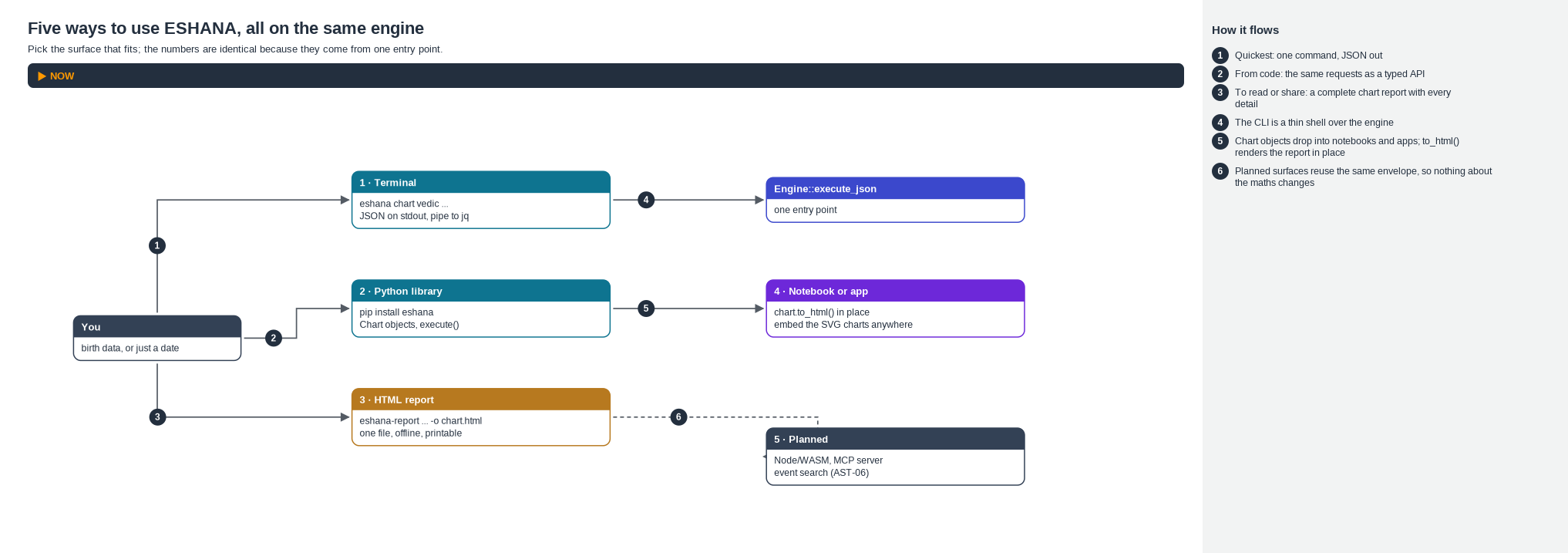
Five ways to use ESHANA, all on the same engine
Pick the surface that fits; the numbers are identical because they come from one entry point.
Download: animated SVG · draw.io (editable)
The numbered steps
| # | From → to | What happens |
|---|---|---|
| 1 | You → 1 · Terminal | Quickest: one command, JSON out |
| 2 | You → 2 · Python library | From code: the same requests as a typed API |
| 3 | You → 3 · HTML report | To read or share: a complete chart report with every detail |
| 4 | 1 · Terminal → Engine::execute_json | The CLI is a thin shell over the engine |
| 5 | 2 · Python library → 4 · Notebook or app | Chart objects drop into notebooks and apps; to_html() renders the report in place |
| 6 | 3 · HTML report → 5 · Planned | Planned surfaces reuse the same envelope, so nothing about the maths changes |
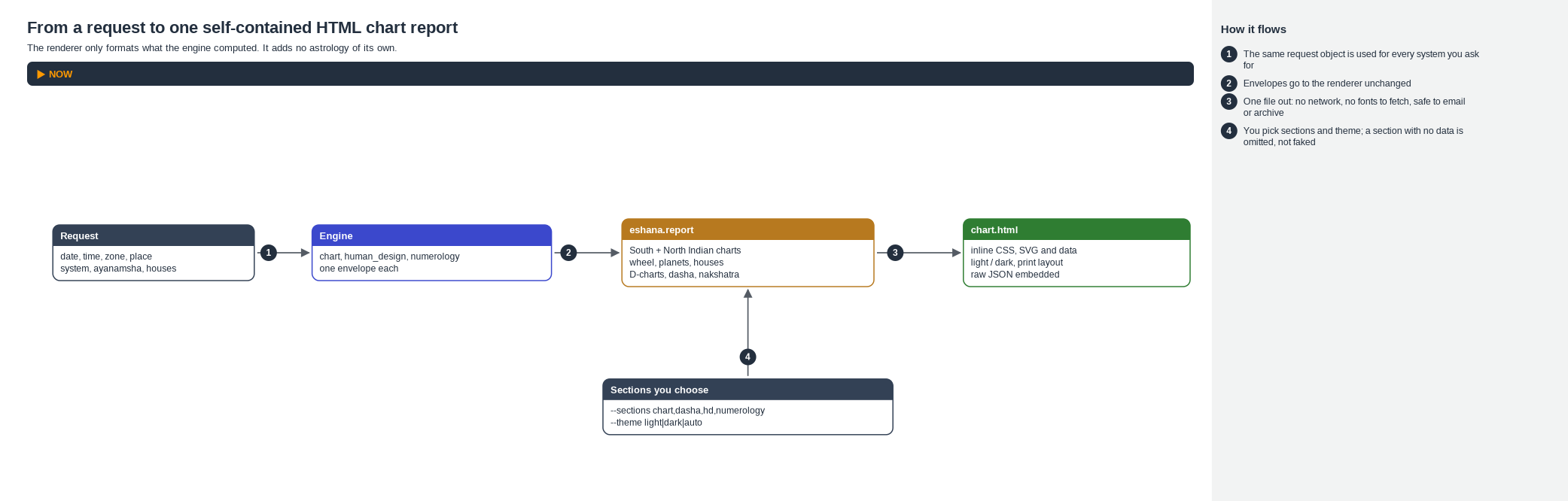
From a request to one self-contained HTML chart report
The renderer only formats what the engine computed. It adds no astrology of its own.
Download: animated SVG · draw.io (editable)
The numbered steps
| # | From → to | What happens |
|---|---|---|
| 1 | Request → Engine | The same request object is used for every system you ask for |
| 2 | Engine → eshana.report | Envelopes go to the renderer unchanged |
| 3 | eshana.report → chart.html | One file out: no network, no fonts to fetch, safe to email or archive |
| 4 | Sections you choose → eshana.report | You pick sections and theme; a section with no data is omitted, not faked |